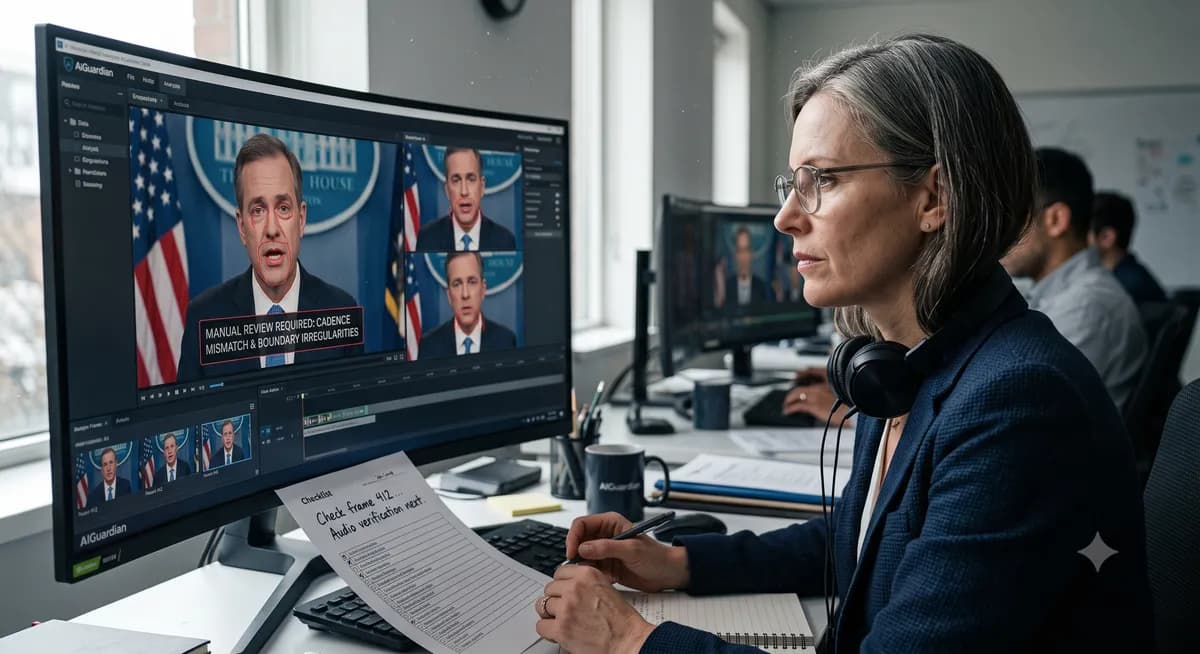
Why Deepfakes Require Multi-Step Verification
Visual realism has improved quickly, but distribution is even faster. Face-swap clips, lip-sync fraud, and fully generative videos can move from creation to social feeds in minutes. Teams in newsrooms, trust-and-safety, insurance, and enterprise security therefore need screening steps before publication, payout, or escalation.
A single confidence score is not enough. Modern deepfake detection works best as a workflow: automated first pass, provenance validation, contextual review, and documented human judgment. AIGuardian’s AI video deepfake detector and AI image detector are designed for that first pass.
Common Red Flags in Synthetic Media
Reviewers should look for multiple weak signals rather than one dramatic glitch:
- Temporal inconsistencies: flickering facial boundaries, unstable identity across frames, or sudden texture changes.
- Geometry artifacts: irregular jawlines, asymmetric earrings, warped eyeglasses, or melted hair edges.
- Motion unnaturalness: stiff head turns, odd blinking cadence, or body motion that does not match camera physics.
- Audio-visual mismatch: lip movement that fails on plosives, flat affect, or missing breath noise.
- Compression oddities: localized blur around the face while the background remains sharp.
No single cue is conclusive. Combine cues with source context: who uploaded it, when it first appeared, and whether an original camera file exists.
Recommended Deepfake Detection Sequence
- Intake and triage: capture URL or file, claim type (fraud, misinfo, identity abuse), and urgency.
- Automated screening: run deepfake detection on the video or image and store the probability plus model notes.
- Provenance check: verify upload account history, earliest known version, EXIF/C2PA when available, and reverse-image/video matches.
- Contextual review: does the claim fit known events? Are lighting, location, and timestamps coherent?
- Escalation: high-risk cases go to a trained investigator or legal/comms owner with a written rationale.
For platform-hosted clips, upload the saved video directly to the AI Video Detector for temporal and frame-level forensics. See also the Deepfake Detector guide.
Operationalizing Deepfake Review
Tools only help when operations are standardized. Define severity tiers (low / medium / high), response SLAs, and retention rules for evidence. Train reviewers to treat detector output as a risk signal: useful for prioritization, insufficient alone for public accusation.
AIGuardian provides image and video workflows so teams can apply a consistent deepfake detection first-pass check before human validation. Pair that with clear playbooks for takedown requests, customer communication, and internal audit logs.
Where Deepfake Workflows Matter Most
- News and publishers: prevent synthetic clips from entering breaking-news pipelines.
- Trust and safety: prioritize scam and impersonation queues.
- Enterprises: verify executive video messages and vendor KYC media.
- Education and research: authenticate audiovisual submissions and interview recordings.
If your team also handles generative stills, keep text, image, and video checks in one review stack so analysts do not bounce between disconnected tools.
Limitations to Communicate Internally
Heavily compressed social uploads, short clips, and heavily edited hybrids can weaken detector confidence. Model updates on the generator side also shift artifact patterns. That is why provenance and human context remain mandatory layers—even when automated deepfake detection is strong.
Build the workflow first. Then choose detectors that explain signals clearly enough for reviewers to act quickly and defensibly.