The Video Generation Revolution
The leap from text-to-image to text-to-video has been staggering. Models like OpenAI's Sora, Runway Gen-3, Luma Dream Machine, and Kling have achieved a level of photorealism and physics-simulation that was previously thought to be years away. These models don't just generate frames; they simulate 3D spaces, lighting, and object permanence.
However, this massive technological leap brings a corresponding leap in the potential for highly convincing misinformation. Distinguishing a genuine news clip from a Sora-generated simulation requires moving beyond static image forensics and entering the complex field of Video AI Detection.
Why Static Image Detectors Fail on Video
You might think a video is just a sequence of images, so an image detector should work, right? In practice, running an image detector on every frame of a video is computationally expensive and wildly inaccurate. Diffusion-based video generators use temporal attention mechanisms. This means a single frame might look 100% flawless to a standard image detector, but when played in motion, the physical laws break down.
The Core Principle: Temporal Consistency
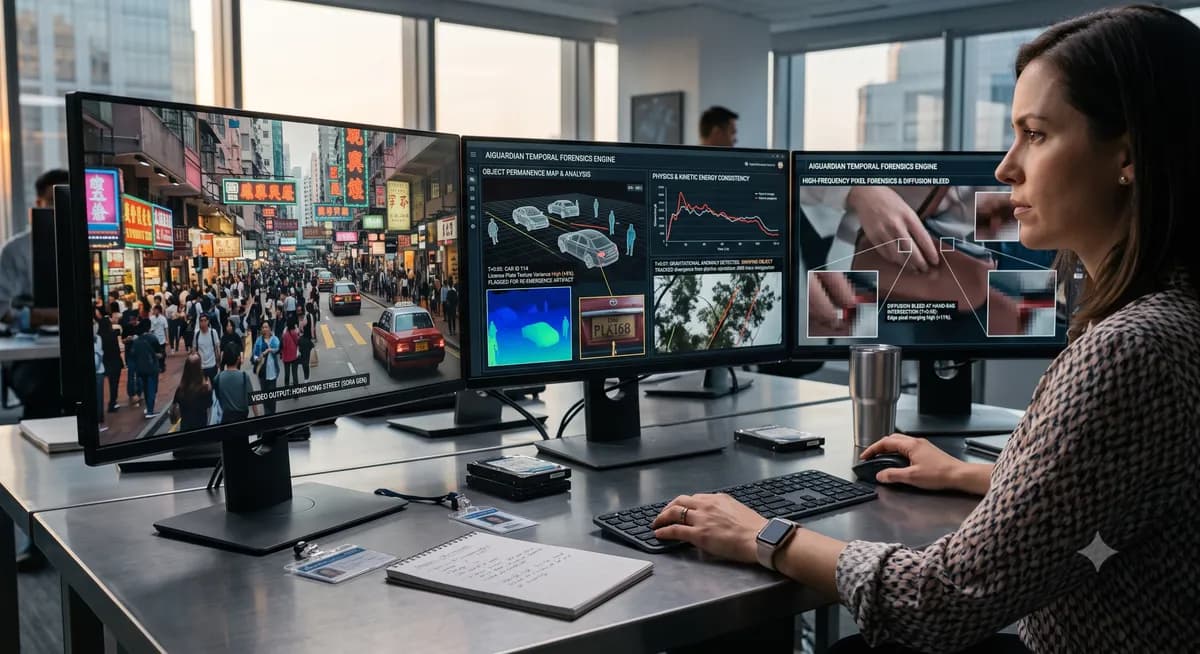
The holy grail of AI video detection is temporal consistency analysis. AIGuardian's video detection engine focuses on how objects behave over time:
- Physics and Gravity Glitches: While AI models simulate physics well, they don't actually "understand" gravity. A video detector tracks the trajectory of falling objects, the splash of water, or the sway of a tree branch to see if the kinetic energy follows actual Newtonian physics over multiple seconds.
- Object Permanence: When an object passes behind a pillar in an AI video and re-emerges, it often changes slightly—a different texture, a slightly shifted logo, or a changed color. AIGuardian creates a spatial map of the video and flags these micro-transformations.
- Flickering and Edge Bleed: The boundaries between moving objects (like a hand waving in front of a face) are incredibly difficult for video diffusion models to render consistently. We analyze the high-frequency pixel data around moving edges to detect "diffusion bleed," where the textures of two overlapping objects temporarily merge.
The Future of Video Forensics
As video generation models scale up their training compute, the visual artifacts will become entirely invisible to the human eye. The defense against synthetic video propaganda relies entirely on mathematical forensics. AIGuardian is continuously training our detection transformers against the latest outputs from Sora, Veo, and Kling, ensuring that trust and safety teams can always verify the reality of the media they consume.
To run your own multi-frame temporal consistency checks on suspicious video clips, use the AIGuardian AI Video Detector pillar tool to extract frame-by-frame forensics and probability scores.