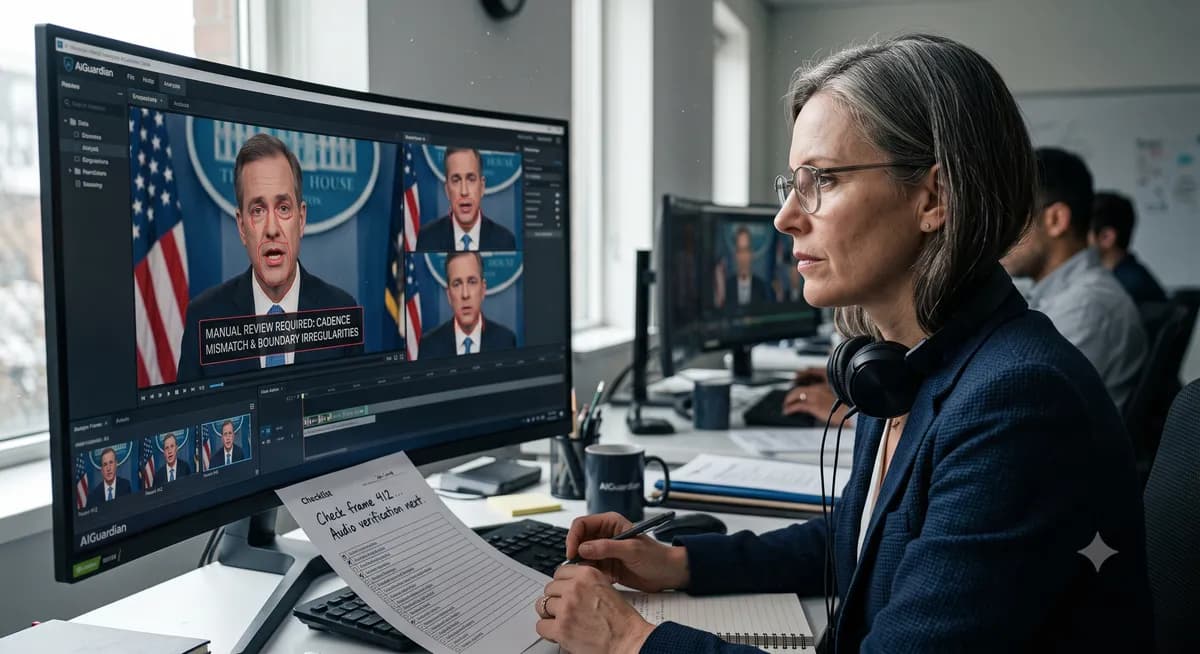
Two Different Modalities, Two Different Sciences
Generative AI operates across multiple modalities—text, images, audio, and video. Consequently, detecting synthetic content requires entirely different scientific approaches depending on the medium. While AIGuardian unifies these checks into a single platform, the engines running under the hood for text and images are vastly different.
How AI Text Detectors Work
Text detectors operate in the realm of linguistics and probability. Large Language Models (LLMs) like GPT-4 construct sentences by calculating the statistical probability of the next word. Because they are optimized for predictability, their writing is mathematically "smooth."
Text detectors reverse-engineer this process. They score text based on two primary factors:
- Perplexity: How surprised the detection model is by the vocabulary choices. Human writers often use quirky or unexpected words; LLMs do not.
- Burstiness: The variance in sentence length. Humans naturally mix short, punchy sentences with long, complex ones. LLMs tend to generate sentences of very similar lengths.
How AI Image Detectors Work
Unlike text, which is a sequence of discrete tokens, images are continuous fields of pixels. Image generators (like Midjourney, DALL-E, or Stable Diffusion) use diffusion models to gradually turn visual "noise" into a coherent picture. This process leaves behind microscopic digital fingerprints.
AI image detectors analyze these visual artifacts, which are often invisible to the naked eye:
- Frequency Domain Analysis: Real photographs contain natural noise patterns captured by a camera sensor. AI-generated images lack this natural noise and instead contain specific high-frequency mathematical artifacts left over from the diffusion process.
- Semantic Inconsistencies: The detector's neural network looks for spatial errors that diffusion models struggle with—such as asymmetrical reflections in a mirror, non-Euclidean architectural geometry, or the infamous "too many fingers" problem.
- Metadata and Provenance: Advanced detectors also read hidden cryptographic watermarks (like C2PA) that ethical AI platforms embed directly into the image file.
Why You Need Both
In modern digital forensics, a single modality is rarely enough. A fake news article might feature human-written text paired with an AI-generated photo to increase its virality. A sophisticated deepfake campaign might use AI text to write the script, AI voice cloning for the audio, and AI face-swapping for the video. A robust platform like AIGuardian provides the full suite of tools needed to secure the entire content pipeline.